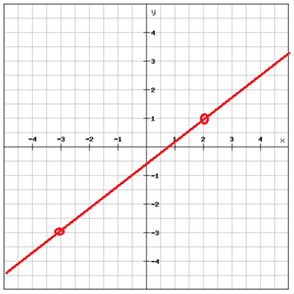
The slope of a linear function
The steepness of a hill is called a slope. The same goes for the steepness of a line. The slope is defined a s the ratio of the vertical change between two points, the rise, to the horizontal change between the same two points, the run.
$$slope=\frac{rise}{run}=\frac{change\: in \: y}{change \: in\: x}$$
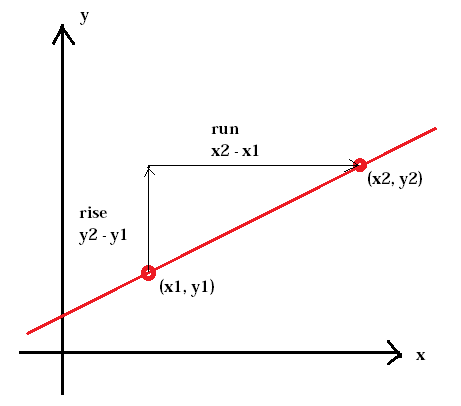
The slope of a line is usually represented by the letter m. (x1, y1) represents the first point whereas (x2, y2) represents the second point.
$$m=\frac{y_{2}\, -y_{1}}{x_{2}\, -x_{1}}$$
It is important to keep the x-and y-coordinates in the same order in both the numerator and the denominator otherwise you will get the wrong slope.
Example
Find the slope of the line
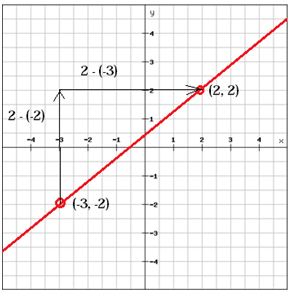
(x1, y1) = (-3, -2) and (x2, y2) = (2, 2)
$$m=\frac{y_{2}\, -y_{1}}{x_{2}\, -x_{1}}=\frac{2-\left ( -2 \right )}{2-\left ( -3 \right )}=\frac{2+2}{2+3}=\frac{4}{5}$$
A line with a positive slope (m > 0), as the line above, rises from left to right whereas a line with a negative slope (m < 0) falls from left to right.
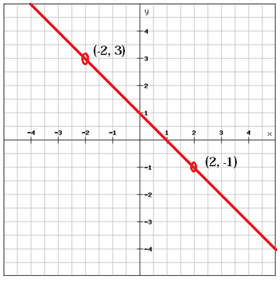
$$m=\frac{y_{2}\, -y_{1}}{x_{2}\, -x_{1}}=\frac{\left (-1 \right )-3}{2-\left ( -2 \right )}=\frac{-1-3}{2+2}=\frac{-4}{4}=-1$$
A line with the slope zero (m = 0) is horizontal whereas a line with an undefined slope is vertical.
In earlier chapters we have looked at how fast a car drives and talked about speed in miles per hour. This is an example of the rate of change. The rate of change compares a change in one quantity to a change in another quantity like at what speed does a car travel if it travels 120 miles in 2 hours?
$$v=\frac{d}{t}=\frac{120}{2}=60\: miles\: per\: hour$$
You can interpret a slope of a line as the rate of change.
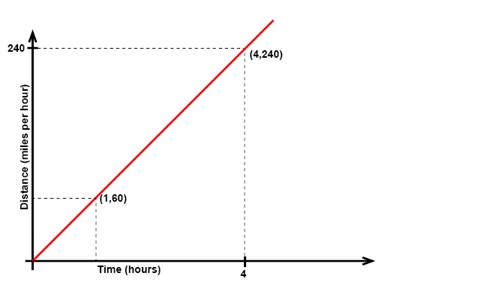
$$v=\frac{d}{t}=\frac{240-60}{4-1}=\frac{180}{3}=60\, miles\, \: per\: \, hour$$
Video lesson
Find the slope of the line