
Solving absolute value equations and inequalities
The absolute number of a number a is written as
$$\left | a \right |$$
And represents the distance between a and 0 on a number line.
An absolute value equation is an equation that contains an absolute value expression. The equation
$$\left | x \right |=a$$
Has two solutions x = a and x = -a because both numbers are at the distance a from 0.
To solve an absolute value equation as
$$\left | x+7 \right |=14$$
You begin by making it into two separate equations and then solving them separately.
$$x+7 =14$$
$$x+7\, {\color{green} {-\, 7}}\, =14\, {\color{green} {-\, 7}}$$
$$x=7$$
or
$$x+7 =-14$$
$$x+7\, {\color{green} {-\, 7}}\, =-14\, {\color{green} {-\, 7}}$$
$$x=-21$$
An absolute value equation has no solution if the absolute value expression equals a negative number since an absolute value can never be negative.
The inequality
$$\left | x \right |<2$$
Represents the distance between x and 0 that is less than 2
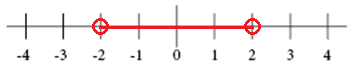
Whereas the inequality
$$\left | x \right |>2$$
Represents the distance between x and 0 that is greater than 2
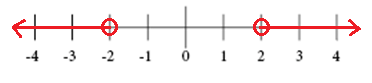
You can write an absolute value inequality as a compound inequality.
$$\left | x \right |<2\: or
$$-2<x<2$$
This holds true for all absolute value inequalities.
$$\left | ax+b \right |<c,\: where\: c>0$$
$$=-c<ax+b<c$$
$$\left | ax+b \right |>c,\: where\: c>0$$
$$=ax+b<-c\: or\: ax+b>c$$
You can replace > above with ≥ and < with ≤.
When solving an absolute value inequality it's necessary to first isolate the absolute value expression on one side of the inequality before solving the inequality.
Example
Solve the absolute value inequality
$$2\left |3x+9 \right |<36$$
$$\frac{2\left |3x+9 \right |}{2}<\frac{36}{2}$$
$$\left | 3x+9 \right |<18$$
$$-18<3x+9<18$$
$$-18\, {\color{green} {-\, 9}}<3x+9\, {\color{green} {-\, 9}}<18\, {\color{green} {-\, 9}}$$
$$-27<3x<9$$
$$\frac{-27}{{\color{green} 3}}<\frac{3x}{{\color{green} 3}}<\frac{9}{{\color{green} 3}}$$
$$-9<x<3$$
Video lesson
Solve the absolute value equation
$$4 \left |2x -1 \right | -2 = 10$$